Key takeaways
- Ladle pouring carries metal from the furnace to the mould, so it cools, its treatment fades and its slag rides along; press-pouring holds the metal in a sealed, heated buffer and pours a metered stream under nitrogen pressure.
- A press-pouring furnace discharges through a teapot-style double siphon, so slag stays in the bath and scrap from slag inclusion drops, while a constant metal level fills every mould to the same weight.
- Holding under nitrogen preserves magnesium, so ductile iron stays in spec from the first cast to the last, and the furnace spends energy only to hold temperature rather than to reheat a cooled ladle.
- Ladle pouring still fits short runs and low tonnage; press-pouring earns its place on steady, automatic lines running demanding metal. CIME has built the coreless CAP press-pouring furnace since 1976.
Two ways to fill a mould
Every foundry running an automatic moulding line has to answer one question: how does the metal get from the melt into the mould? There are two established answers. Ladle pouring carries a charge of metal in a ladle and tips it into each mould, by hand or with an automatic pouring ladle. Press-pouring keeps the metal still in a sealed, heated furnace and uses gas pressure to push a metered stream onto the line. Both reach the same mould, but they treat the metal very differently on the way, and that difference is what sets scrap rate, alloy chemistry and line uptime.
A ladle is a passive vessel. Once metal leaves the melting furnace it cools, its treatment fades, and its slag rides along with it. A press-pouring furnace is an active buffer: it holds the metal at temperature, under an inert cover, ready to fill the first mould and the last mould of a shift to the same specification. CIME has built the coreless press-pouring furnace, the CAP, since 1976, and the reasoning behind the switch is worth setting out plainly.
Note
A press-pouring furnace does not replace the melting furnace. It sits between the melt and the moulding line as a heated holding and pouring buffer. Ladle pouring uses no such buffer: the ladle is filled, carried and tipped, and whatever the metal does in that time it does uncorrected.
How each behaves on the floor
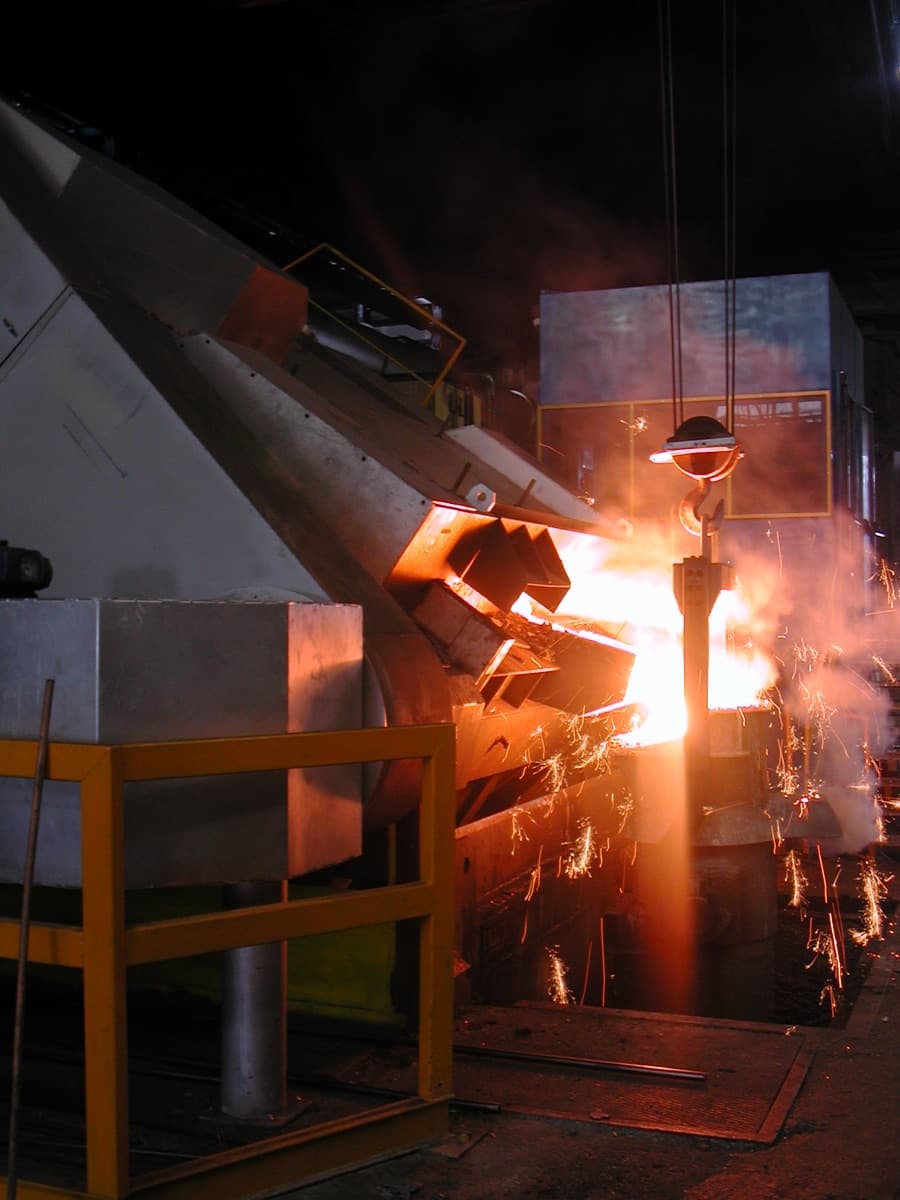
Follow a ladle through one cycle. It is filled from the furnace, carried to the line, and tipped over a lip so metal spills into the pouring cup. In that short trip the temperature drops, so the melt is often tapped hotter than it needs to be to leave a margin, which costs energy and stresses the refractory. On ductile iron the magnesium that makes the graphite nodular begins to fade the moment treatment ends, so a late pour can drift out of specification. And because the ladle tips, slag on the surface tends to travel with the stream and seed inclusion defects in the casting.
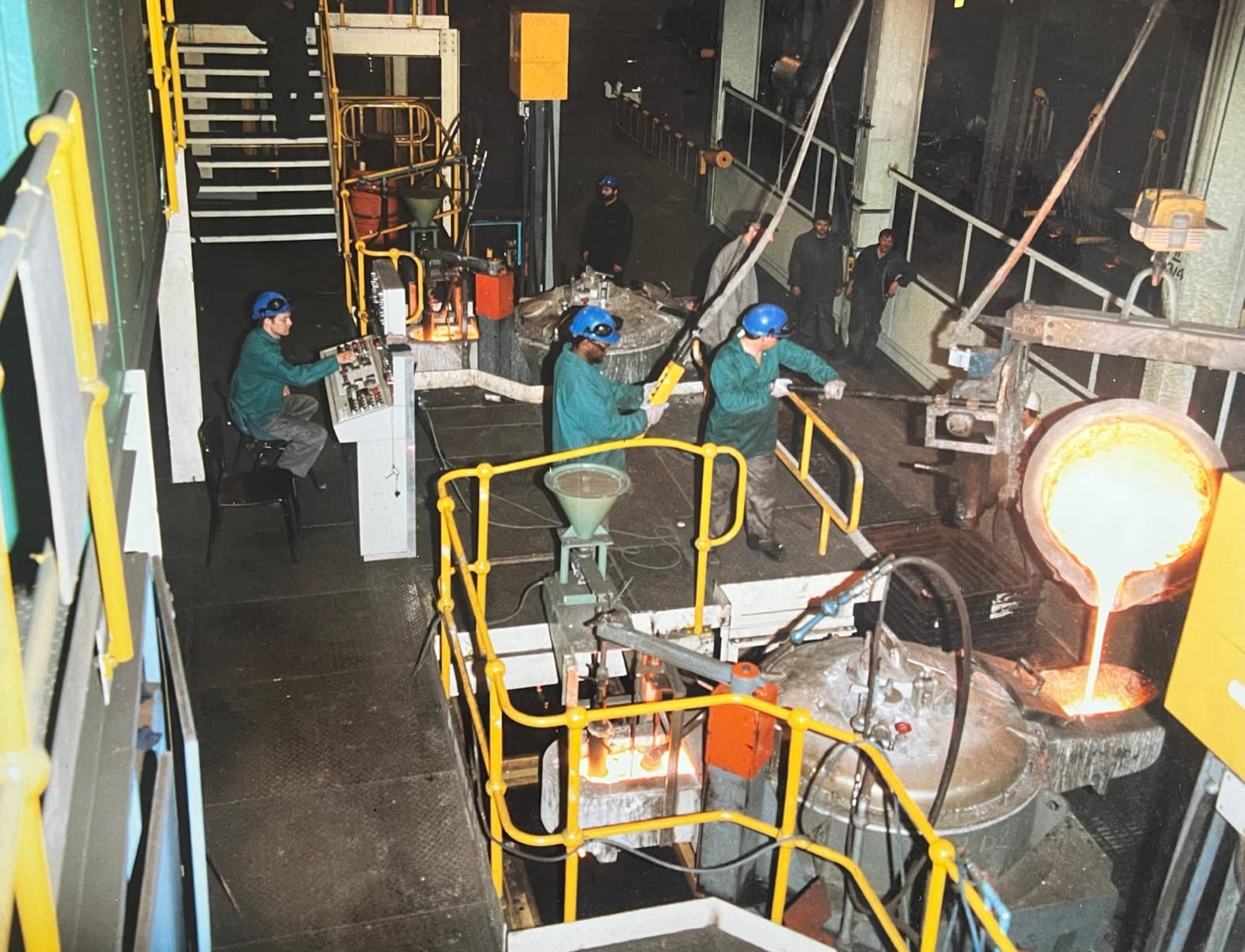
A press-pouring furnace inverts every one of those steps. The metal is held in a sealed coreless crucible whose coil keeps the bath and both siphons at temperature, so nothing cools and nothing freezes between casts. To pour, the furnace raises inert nitrogen pressure inside the sealed body and pushes the melt up a heated discharge siphon, past a stopper-rod that meters the flow, out as a clean, slagless stream. The slag stays behind in the bath. For the full mechanics of the pour, see press-pouring, explained.
Ladle vs press-pouring, head to head
Put press pouring vs ladle pouring side by side on the properties a foundry specifies against, and the pattern is consistent. A ladle inherits whatever the metal does between the furnace and the mould. A press-pouring buffer removes that interval.
Read down the table and one theme repeats: the ladle is exposed to time and air, the press-pour buffer is not. That is why a heated, sealed buffer changes the economics of an automatic line, and why the pourability of ductile iron, the hardest case, is where the difference shows first. The coreless principle that keeps the whole bath and its siphons hot is set out in coreless vs channel induction.
Carry the metal in a ladle and it cools, fades and picks up slag on the way. Hold it in a sealed, heated buffer and the first mould and the last are filled the same.
Why modern foundries switch
The switch is rarely about a single number. It is the sum of four things a ladle cannot offer. First, yield: the teapot-style double siphon keeps slag out of the discharge, so scrap from slag inclusion drops sharply. Second, chemistry: holding under nitrogen preserves magnesium, so ductile iron stays nodular from the first cast to the last and re-treatment is reduced. Third, consistency: the metal level at the nozzle is held constant by pressure regulation, so every mould is filled to the same weight regardless of how full the furnace is. Fourth, energy: the furnace spends only the power needed to hold temperature, not to reheat metal that cooled in a ladle, and it can superheat quickly, 60 °C/h or more, when a grade change calls for it.
Uptime is the quiet advantage. When an automatic line stops, a ladle-fed shop casts the waiting metal back into ingots and remelts it later, paying twice. A press-pouring furnace holds the bath under nitrogen until the line restarts, with no ingoting and no lost heat. Across a shift, those saved remelts, the tighter chemistry and the lower scrap are what move a foundry from ladle pouring to a CAP. See the CAP press-pouring furnace for the full specification, or the core technology for how the coreless platform underpins it.
When ladle pouring still fits
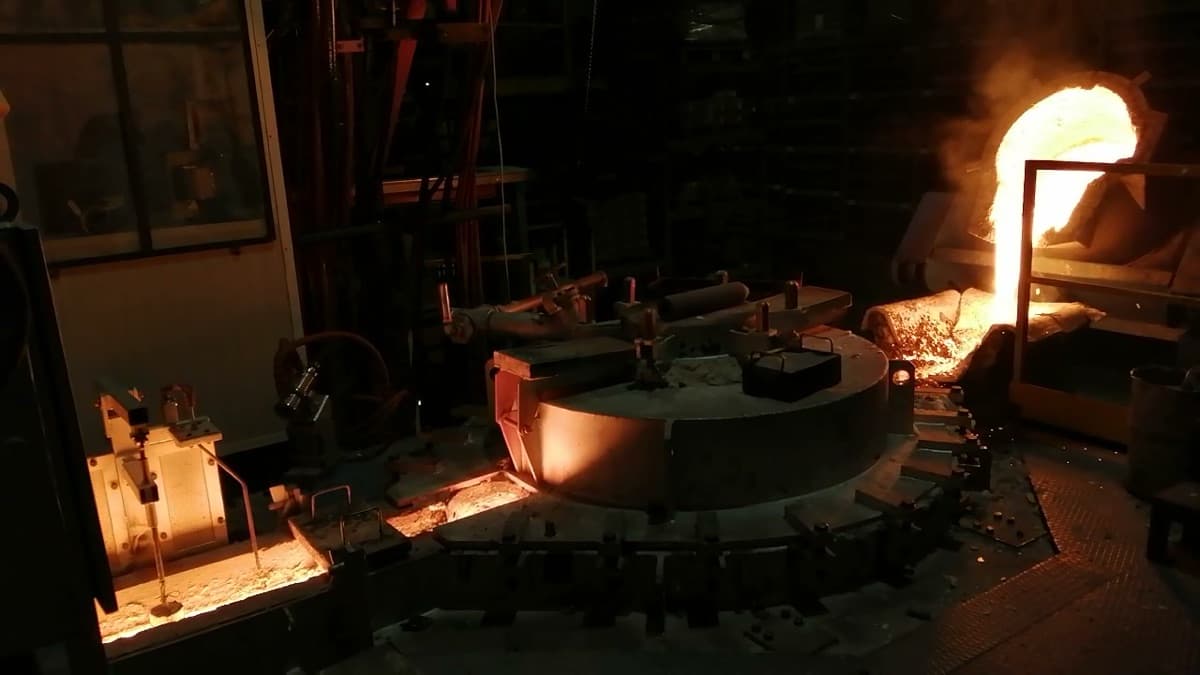
None of this makes ladle pouring wrong. For a jobbing shop with short runs, frequent alloy changes across unrelated orders, or low daily tonnage on a single manual line, a ladle is simple, flexible and cheap to run, and the case for a heated buffer is weaker. Press-pouring earns its place where the volume is steady, the line is automatic and the metal is demanding, ductile iron above all. The honest way to choose is by the line, not the brochure: match long, repeatable runs of treated iron to a press-pouring buffer, and keep the ladle for the work it still does best.
Key point
The question is not whether press-pouring beats ladle pouring in the abstract. It is whether the line runs enough treated iron, steadily enough, that removing the trip from furnace to mould pays for the buffer. On an automatic ductile-iron line, it usually does.
Frequently asked questions
What is the difference between press pouring and ladle pouring?
Ladle pouring carries metal in a ladle and tips it into each mould, so the melt cools, its treatment fades and its slag travels with it. Press pouring keeps the metal in a sealed, heated furnace and uses inert nitrogen pressure to push a metered, slagless stream onto the line, holding the bath at temperature between casts.
Does press-pouring reduce scrap compared with ladle pouring?
Yes. A press-pouring furnace discharges through a teapot-style double siphon, so slag stays behind in the bath instead of riding the stream into the mould. That removes a common source of slag-inclusion defects, and the metered pour fills every mould to the same weight, both of which lower scrap on an automatic line.
Why is press-pouring better for ductile iron than a ladle?
Ductile iron loses magnesium as it waits, which is what makes a late ladle pour drift out of spec. A press-pouring furnace holds the bath under inert nitrogen and keeps it at temperature, so magnesium fades far less and the iron stays nodular from the first cast to the last, with less re-treatment.
When does ladle pouring still make sense?
For short runs, frequent unrelated alloy changes or low daily tonnage on a manual line, a ladle is simple and flexible and a heated buffer is hard to justify. Press-pouring pays off where the line is automatic, the volume is steady and the metal is demanding, ductile iron in particular.
References and sources
- Foundry Trade Journal, technical article on automatic press-pouring, 2006.
- Cast Metal Times, coreless induction and pouring practice, 2004.
- CIME S.r.l., internal process documentation on CAP press-pouring, Turin.